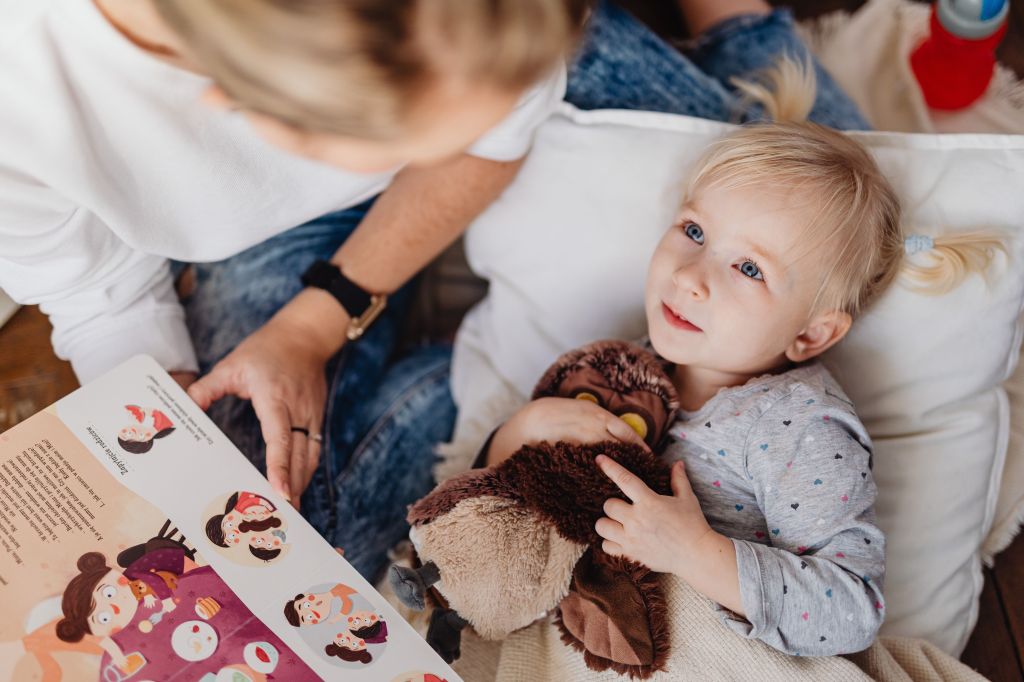
We were stuck in traffic, the kind that turns a fifteen-minute drive into forty, and my daughter, just a little over two years old, was starting to unravel in her car seat. Out of pure desperation, I started telling her a story about a bear named Boots who had lost his jar of honey somewhere in the forest and was too embarrassed to ask anyone for help. I had no plan. I was making it up sentence by sentence, watching her in the mirror to see what landed.
She stopped crying almost immediately. By the second bear obstacle, she was asking questions. Where did he lose it? Was he hungry? Did he ask the fox? By the time we pulled into the driveway, Boots had found his jar of honey, made a friend, and become a permanent character who was requested by name for the next two years.
There was no book anywhere near that car. And yet everything that happens when I read a story aloud to a child was happening in that back seat.
What’s Actually Going On When a Child Listens to a Made-Up Story
As a teacher, I spend a lot of time explaining to parents why reading aloud matters. What I don’t talk about often enough is that stories don’t have to arrive on a printed page to do that work. When a child listens to any story, whether it’s coming from a book or from your own head while you drive, they are doing the same cognitive heavy lifting. They’re holding characters in their memory. They’re predicting what happens next. They’re building the sense that events connect to each other in a way that makes sense, which is the exact skill they’ll later need to understand a paragraph on a page.
Research on oral storytelling backs this up. Children’s ability to tell and follow a story out loud at around age five is one of the strongest predictors of how well they’ll understand what they read years later. Vocabulary grows the same way it does through picture books, too: by hearing words used in real contexts, attached to real feelings, rather than by memorizing a definition. At home, we speak Japanese and English. The stories I read and tell her about are all in English. It is amazing how wide her vocabulary is just from listening to different stories.
There’s also something a made-up story can do that a book can’t. It can be about your child specifically. It can happen anywhere, with nothing in your hands. And because you’re inventing it as you go, it teaches your child something quietly important: that stories aren’t only something found in books written by other people. Stories are something anyone can make, including them.
Why This Matters Most for the Kids Who Resist Sitting Still
I think about the children in my class who fidget the moment a picture book comes out. Not because they dislike stories, but because sitting still, facing forward, staring at a page for ten minutes is genuinely hard for some four- and five-year-olds. Their bodies want to move, and a book asks them not to.
Oral storytelling asks nothing of the body. A child can be in the bath, building with blocks, walking to the shops, or lying upside down on the sofa and still follow every word. For a wriggly child, or a child who has already decided that “reading time” means sitting quietly and being good, a story with no book attached can slip past all of that resistance. It’s still a story. It’s just not doing the thing they’ve learned to associate with pressure.
Grandparents and caregivers often have an advantage here too, even without realizing it. Family stories, the ones about what Grandad’s dog used to do, or the time Auntie got lost at the fair, are oral storytelling in its oldest form, and they carry the exact same benefits, plus something a made-up bear never can: a sense of belonging to a family with a history.
How to Actually Do This (Especially If You Feel Like You’re Bad at It)
I hear this a lot from parents. I’m not creative. I don’t know how to make up a story on the spot. Here’s the secret: neither did I, that first day in the car. The trick isn’t creativity, it’s structure. Give yourself a character with one clear problem, and let your child help you solve it. What should the bear do? Should he ask the fox for help? That question does two things at once. It buys you thinking time and turns your child into a co-author, where the real engagement lives.
Repetition is your friend here too, not your enemy. The story doesn’t need to be new every time. In fact, a character your child already knows, facing a new small problem, tends to land better than a brand new invention each time, because the comfort of the familiar frees up their attention for the new part.
You also don’t need a quiet, dedicated moment for this, the way a bedtime book often requires. Car rides, bath time, the walk to school, folding laundry together, any stretch where hands or eyes are busy but ears are free, is a genuinely good window for a story. For some children, especially the ones who find books hard to sit with, this kind of storytelling might be where their love of story actually begins, long before it ever moves onto a page.
The Story Doesn’t Need to Be Good
I want to say this plainly because I think it’s the part that stops parents from trying. Your made-up story does not need to be clever, or well structured, or even make complete sense. Boots the bear’s adventures were, frankly, a bit ridiculous most days. That was never the point. The point was a voice, a bit of attention, and a small shared world that belonged to just the two of us for a few minutes. That’s what builds a reader, long before any book gets involved.
If you’re looking for simple, low-pressure ways to build on this at home, my printable activity packs for ages 3 to 6 are in my Etsy shop, and I also write sight-word and early-reading books on Amazon. Both are on the website if you’d like to take a look.


Leave a comment